


How to do first aid for fractures and splints
One of the most important steps that every citizen should know is first aid for fractures. He or she needs to know exactly what to do when dealing with a patient who is suspected of having a fracture to further reduce the risk of further injury, after which the patient is taken to a medical center.

What are the first aid steps for a fracture patient?
This article tries to help you when you see the patient with the following condition.
Situation: You see a person who does not have a clear wound and is conscious and breathing, but for some reason it seems that his arm or leg is broken.
If you encounter this situation, you should follow the steps below
Call the emergency room immediately
Reassure the patient that you are caring for him
Treat it like a broken limb when you are not sure if it is a broken limb
Move the affected limb only when necessary and avoid moving it unnecessarily and repeatedly
The first priority in dealing with a critically ill patient is to control the patient’s consciousness, breathing, blood pressure, and bleeding. So if the patient is unconscious, does not breathe or has difficulty breathing, his pulse is weak or does not beat, or if he is bleeding from the wound, these problems should be addressed first and then the initial measures for fracture should be taken.
A limb suspected of being fractured must be immobilized. This immobilization can be done by tying the limb to the trunk or the opposite limb or by splinting
How is splinting done?
The most important primary care for a broken or suspected limb is to immobilize it, and the most appropriate way to immobilize the limb is to use a splint or splint.
A splint or splint is a device that is either pre-made for this purpose or the helper makes it using the tools available in the accident environment and then supports it by tying it to the limb and causing it to become immobile.
The steps of immobilizing the limb with a splint are:
Readiness
Reassure the patient that you are caring for him
Remove tight clothing from the limbs and open it. Tight clothing causes vascular problems for the injured limb. The limb should not be under external pressure, so any clothing that puts pressure on the limb from the outside should be removed from his body. Of course, do not remove the patient’s foot if it is in boots unless there is active bleeding. Putin himself is the best splint for a broken leg
Take the jewelry off the limb and put it in the person’s pocket and tell him / her that you are doing this so that if the limb is swollen, it will not be pressed by the jewelry.

Obtain materials to make a splint
A tall wooden board, a tall tree branch, an umbrella, a cane of a piped newspaper, or anything stiff enough to immobilize an upper joint and a lower joint of a broken bone. Is. If nothing is found, you can close the upper limb to the chest and the lower limb to the opposite limb
Cover the splint with something soft, such as clothes, cloth, towels, or even tree leaves
Find a string to tie the splint. This string can be a strip of clothing, a belt or a shoelace.
Test the splint to make sure it is not tight
The strings should be tight enough to hold the splint tightly to the limb
Check blood flow to the limbs again. If the blood flow is disturbed after closing the splint, loosen the string
Hang the splinted upper limb around the neck
Use a piece of cloth, string or belt to hang the limb
Also read: What is rheumatoid arthritis and what are its symptoms?
The hand should be hung around the neck so that the wrist joint is slightly above the elbow joint
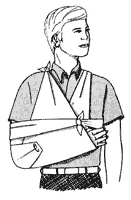
In cases where no splinting device is available, cover the affected upper limb with a piece of cloth to the trunk and the affected lower limb with a piece of cloth to the opposite limb. In doing this method, pay attention to the following points
The ligament of the injured limb should be tight enough to prevent movement, but not so tight as to impede blood flow to the limb.
If you close the lower limbs, put a soft enough cloth between the ankles and between the knees so that they do not put pressure on each other.
Knit the fabric on a healthy limb
Below are pictures related to different methods of limb immobilization.
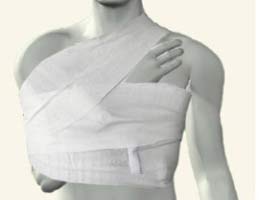
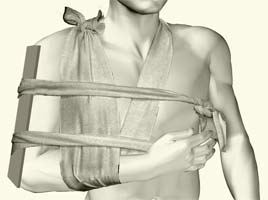
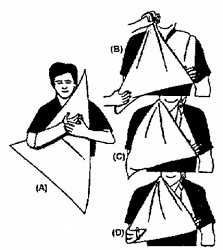
For temporary immobilization of a broken limb anywhere on the upper limb, especially in the shoulder, it can be attached to the trunk using a large piece of cloth. The pictures above show different methods for this purpose

Two different ways to close the arm and elbow using a splint

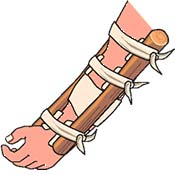
Two different methods of tying the forearm and wrist using a splint
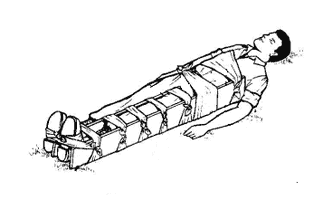

Two different methods of immobilizing hip, knee or leg fractures using a long splint
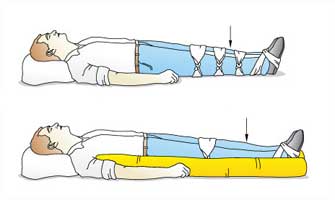
Temporary immobilization of the lower limb by attaching it to the opposite limb
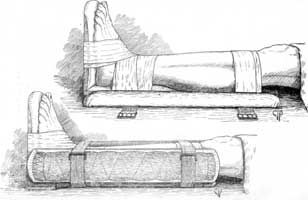
Two different methods of immobilizing an ankle fracture using a splint

Immobilize a broken leg or ankle by tying a bulky garment (like a thin pillow) around it
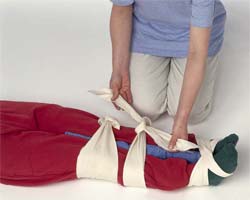
Temporarily immobilize a broken leg or ankle by tying two limbs together

Temporarily immobilize the spine by placing a folded cloth under the lower back and neck
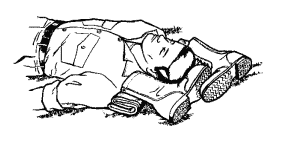
Temporarily immobilize the neck by placing objects around the head